
12 October 2005



04 October 2005
A Day to Breathe
One would think that a work day that begins at 8:00 AM and ends at 8:00 PM would be something other than a break, but I returned the last of my first batch of freshman papers today.
And the next batch comes in Thursday.
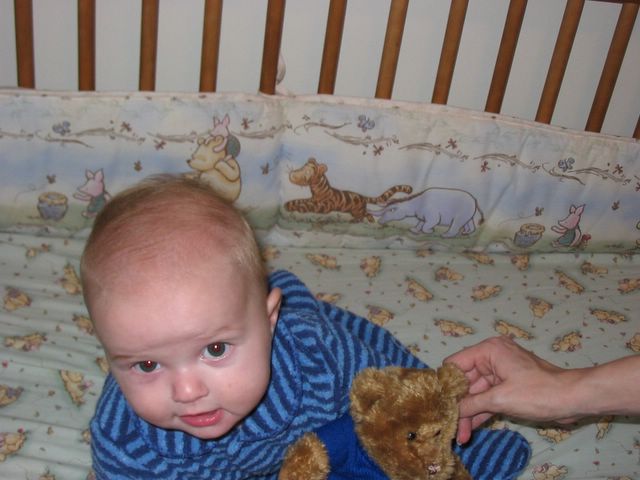
Micah got sick on the first one's due date, so that threw the whole process off. I'm fairly certain I'll get this batch put away far more efficiently.
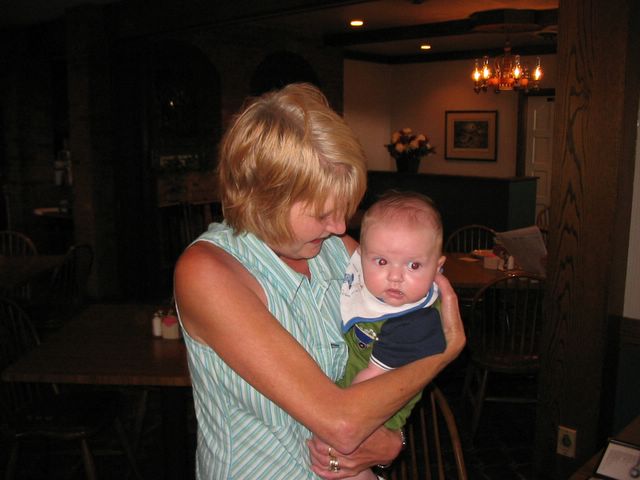
But I have paper proposals due next week, so still no time to post substantially. All the same, look for baby pictures later this week--I'm sure I can sneak some in!
And the next batch comes in Thursday.
Micah got sick on the first one's due date, so that threw the whole process off. I'm fairly certain I'll get this batch put away far more efficiently.
But I have paper proposals due next week, so still no time to post substantially. All the same, look for baby pictures later this week--I'm sure I can sneak some in!
23 September 2005
Hard Work
Okay, so it's been nearly a month with no new posts...
I'll just say that working on a Ph.D, teaching classes, raising an infant, and doing a hundred other things takes up some time, aight?
Posts will come... we must be patient.
I'll just say that working on a Ph.D, teaching classes, raising an infant, and doing a hundred other things takes up some time, aight?
Posts will come... we must be patient.
06 September 2005
Unease with Libertarianism, Part Deux
No, I haven't posted the sequel to that last reflection. Let the one who can write long theoretical blog posts while starting a Ph.D program cast the first stone, eh?
Anyway, I've been thinking, even if not writing, and I wonder what goods can come of Christian reflections on nation-state politics. Theology is supposed to be the disciplined reflection on the practices of the Church for the sake of edifying the Body. What would an analogous practice look like for a Christian reflecting on Caesar's practices? I'm certain folks have written books on it, but if you're reading this, you'd prefer what I can cook up here in front of a computer screen, so let me get to cookin'!
I'd say that the Christian's role within an empire (and I mean that in as neutral a sense as is possible--I don't think that England or Japan or any nation-state with an armed border is outside the category) is to join and remain a member of a counter-politics, an Ekklesia in the midst of the Imperium. I think that the eucharist and baptism, being transnational and transgenerational practices, stands as the faithfulness-embodying counterparts to the military parades and pledges to flags and other disciplines that make people believe in entities called "nations." (As is often mentioned in conjunction with space exploration, the lines that we draw on maps don't show up when one gets high enough above the planet's surface.) From within that counter-politics, the Christian gains a critical perspective (one that acknowledges neither Jew/Gentile nor male/female nor Scythian/barbarian divisions in the ways that empires do) from which she or he might speak Truth.
That's the framework from which I'm attempting to operate here. I believe that the Church, as God's semiotic/martyrological/eschatological Body, can speak to nation-states the truths that their violence would otherwise blind them to. I'm intentionally comparing apples and oranges, churches and states, because I believe that the oranges would be better oranges if they tasted more like apples. (In reality, I'm more of an orange-eater myself.) Against the Machiavellian tendency to excuse nation-states and rulers of nation-states for being Machiavellian, I'll claim that the Church, the real politics that stand in resistance to the travesty-politics of empire, stands as the standard by which nations now are judged.
Of course, my grasp of theology and my grasp of history in the age of nation-states are both tenuous. That won't stop me. Instead, I'll welcome critiques from historians and from theologians as I attempt to forge some kind of theoretical framework, knowing still that others have likely fashioned better ground rules. Such is the hubris of the blogger.
So for those who have waited for my next venture into economics and politics and theology... keep waiting. This was just a taste and some methodological musings. I'll get back to the task at hand... but right now, I've got Shakespeare to read. Back anon.
Anyway, I've been thinking, even if not writing, and I wonder what goods can come of Christian reflections on nation-state politics. Theology is supposed to be the disciplined reflection on the practices of the Church for the sake of edifying the Body. What would an analogous practice look like for a Christian reflecting on Caesar's practices? I'm certain folks have written books on it, but if you're reading this, you'd prefer what I can cook up here in front of a computer screen, so let me get to cookin'!
I'd say that the Christian's role within an empire (and I mean that in as neutral a sense as is possible--I don't think that England or Japan or any nation-state with an armed border is outside the category) is to join and remain a member of a counter-politics, an Ekklesia in the midst of the Imperium. I think that the eucharist and baptism, being transnational and transgenerational practices, stands as the faithfulness-embodying counterparts to the military parades and pledges to flags and other disciplines that make people believe in entities called "nations." (As is often mentioned in conjunction with space exploration, the lines that we draw on maps don't show up when one gets high enough above the planet's surface.) From within that counter-politics, the Christian gains a critical perspective (one that acknowledges neither Jew/Gentile nor male/female nor Scythian/barbarian divisions in the ways that empires do) from which she or he might speak Truth.
That's the framework from which I'm attempting to operate here. I believe that the Church, as God's semiotic/martyrological/eschatological Body, can speak to nation-states the truths that their violence would otherwise blind them to. I'm intentionally comparing apples and oranges, churches and states, because I believe that the oranges would be better oranges if they tasted more like apples. (In reality, I'm more of an orange-eater myself.) Against the Machiavellian tendency to excuse nation-states and rulers of nation-states for being Machiavellian, I'll claim that the Church, the real politics that stand in resistance to the travesty-politics of empire, stands as the standard by which nations now are judged.
Of course, my grasp of theology and my grasp of history in the age of nation-states are both tenuous. That won't stop me. Instead, I'll welcome critiques from historians and from theologians as I attempt to forge some kind of theoretical framework, knowing still that others have likely fashioned better ground rules. Such is the hubris of the blogger.
So for those who have waited for my next venture into economics and politics and theology... keep waiting. This was just a taste and some methodological musings. I'll get back to the task at hand... but right now, I've got Shakespeare to read. Back anon.
04 September 2005






02 September 2005






27 August 2005


21 August 2005


20 August 2005
I will only delete spam
I just deleted a comment from one of my posts, and I feel as if posting this promise will make me accountable: if someone disagrees with me or questions me or whatever, I'll leave those comments there. If someone spams my blog, that I'll delete.
Okay, I feel better now.
Okay, I feel better now.
14 August 2005



08 August 2005
Unease with Libertarianism
I was thinking about politics today, particularly about the terms in which politics could more helpfully be talked about. As it stands, folks in the churches I know and love generally talk about "issues" without really engaging what it means for people to be political or rational or even spiritual animals, and I think that our Christian witness suffers for it; if we're merely partisans of one or another American political faction, to what extent can we call our common witness Christian?
More specifically I was thinking about wealth and the ways we speak about it. It's no big surprise that capitalism is the dominant economic ideology in the lands claimed by Washington. But the church's unwillingness (or inability) to speak critically about such things is troubling. While churches agree and disagree about whether or not centralized governments should regulate lying or sex or those such things, nobody seems to question the purely monetary model of "property" that underlies the way that we live together.
Even Plato seems to have known better. In his Republic, the city is the locus of property. The producers generate material goods and perform specialized services, and the civil servants police things and fight wars, and the philosopher-kings rule using noble lies among their other stately tools (I'm becoming more and more convinced that the U. of Chicago group, the students of Leo Strauss, are intentionally reclaiming this Platonic tool). What is proper to each class, and thus to each person, is duty and function. There's no sense that any of the producers is thinking that "my" crops or coins or whatever are ending up in the hands of the kings; rather, the city itself is the "proper" steward of these things. Later, in monastic life, similar things happen--whatever was once proper to this or that man becomes the common "property" of the community, and each monk's "property" becomes not a monetary holding but a participation in a larger social body.
But modern notions of property, whether capitalist or communist, seem to presuppose "property" as a liquid asset, something to be bought and sold without any eye for its function as a communal good. Marx is no less guilty of this than any capitalist; the revolution presupposes that a finite, liquid pool of resources is the aim of the revolution (if I've got this wrong, any Marx scholar is quite welcome to correct me). In The German Ideology, the end of revolution seems to be a collection of functionally equivalent individuals, not any sort of community.
In libertarian/Republican frameworks, it's even scarier and even more Nietzschean. It doesn't matter how the rich got rich or the powerful got powerful; their duty is to retain that power and money. Not to do so would be to cave in (according to Nietzshce) to the ethics of resentment (echoed in the last fifteen years or so by Limbaugh and company's rants about "class warfare"). If a few of the poor win or deal or work themselves to death and earn a little wealth, the moneyed class points to them with great rejoicing and says that "anyone can make it in America." But if someone points to the thousand who can't accumulate wealth, even while working themselves to death, it's "class warfare." In the meantime, they continue to congratulate themselves for being wealthy and powerful, sneering at the working poor as "the lazy class."
I'll probably post more on this in the days to come; right now, I'm just trying to establish some sort of theoretical framework within which I can talk and write about national politics without automatically falling into one or another megaparty's camp and, more importantly, without assuming that the nation to whom a person pays taxes automatically becomes that person's primary political identity-maker. More later.
More specifically I was thinking about wealth and the ways we speak about it. It's no big surprise that capitalism is the dominant economic ideology in the lands claimed by Washington. But the church's unwillingness (or inability) to speak critically about such things is troubling. While churches agree and disagree about whether or not centralized governments should regulate lying or sex or those such things, nobody seems to question the purely monetary model of "property" that underlies the way that we live together.
Even Plato seems to have known better. In his Republic, the city is the locus of property. The producers generate material goods and perform specialized services, and the civil servants police things and fight wars, and the philosopher-kings rule using noble lies among their other stately tools (I'm becoming more and more convinced that the U. of Chicago group, the students of Leo Strauss, are intentionally reclaiming this Platonic tool). What is proper to each class, and thus to each person, is duty and function. There's no sense that any of the producers is thinking that "my" crops or coins or whatever are ending up in the hands of the kings; rather, the city itself is the "proper" steward of these things. Later, in monastic life, similar things happen--whatever was once proper to this or that man becomes the common "property" of the community, and each monk's "property" becomes not a monetary holding but a participation in a larger social body.
But modern notions of property, whether capitalist or communist, seem to presuppose "property" as a liquid asset, something to be bought and sold without any eye for its function as a communal good. Marx is no less guilty of this than any capitalist; the revolution presupposes that a finite, liquid pool of resources is the aim of the revolution (if I've got this wrong, any Marx scholar is quite welcome to correct me). In The German Ideology, the end of revolution seems to be a collection of functionally equivalent individuals, not any sort of community.
In libertarian/Republican frameworks, it's even scarier and even more Nietzschean. It doesn't matter how the rich got rich or the powerful got powerful; their duty is to retain that power and money. Not to do so would be to cave in (according to Nietzshce) to the ethics of resentment (echoed in the last fifteen years or so by Limbaugh and company's rants about "class warfare"). If a few of the poor win or deal or work themselves to death and earn a little wealth, the moneyed class points to them with great rejoicing and says that "anyone can make it in America." But if someone points to the thousand who can't accumulate wealth, even while working themselves to death, it's "class warfare." In the meantime, they continue to congratulate themselves for being wealthy and powerful, sneering at the working poor as "the lazy class."
I'll probably post more on this in the days to come; right now, I'm just trying to establish some sort of theoretical framework within which I can talk and write about national politics without automatically falling into one or another megaparty's camp and, more importantly, without assuming that the nation to whom a person pays taxes automatically becomes that person's primary political identity-maker. More later.
30 July 2005
High Level Literary Theory and the Amateur
I should have noticed when I read Lentricchia's "Confessions of an Ex-Literary Critic" years ago, but I've realized recently why I can't get on board, at least not all the way, with the various "hermeneutics of suspicion" movements: I'm just not jaded enough.
Perhaps, years from now, when Chaucer and Shakespeare and Milton have said to me all they have to say (may the day never come!), when Dickens ceases to shock and shame me into awareness of the poor (may my heart never be so hard!), when Ovid and Sophocles stop looking so darn classical in my starstruck eyes (may I go blind first!)--perhaps then I'll be interested in their Marxist "secret agendas" or in their "deep structural" oppressive characters. Perhaps when that day comes, I'll be able to join in the ranks of the Wordsworth critics so convinced that they've got him whipped when it comes to avoiding self-delusion.
A pity that day will be.
For now my hermeneutics have to be something more like a "hermeneutics of Malorian worship." When one knight in Morte d' Arthur extolled the worth of a superior, through words and through symbolic actions such as bowing and presenting arms, Malory without hesitation called that action "worship." Now I'm not talking about the nasty latria stuff that gets people in a bind about idol-latria and such. No, just the acknowledgment that Malory and Marlowe and Herbert and Coleridge are more worthy knights than Gilmour.
Perhaps this hermeneutical stance will work its way into my dissertation or research. Maybe not. But that's three blog posts in two days--my little mind must be bearing some crazy fruit!
Perhaps, years from now, when Chaucer and Shakespeare and Milton have said to me all they have to say (may the day never come!), when Dickens ceases to shock and shame me into awareness of the poor (may my heart never be so hard!), when Ovid and Sophocles stop looking so darn classical in my starstruck eyes (may I go blind first!)--perhaps then I'll be interested in their Marxist "secret agendas" or in their "deep structural" oppressive characters. Perhaps when that day comes, I'll be able to join in the ranks of the Wordsworth critics so convinced that they've got him whipped when it comes to avoiding self-delusion.
A pity that day will be.
For now my hermeneutics have to be something more like a "hermeneutics of Malorian worship." When one knight in Morte d' Arthur extolled the worth of a superior, through words and through symbolic actions such as bowing and presenting arms, Malory without hesitation called that action "worship." Now I'm not talking about the nasty latria stuff that gets people in a bind about idol-latria and such. No, just the acknowledgment that Malory and Marlowe and Herbert and Coleridge are more worthy knights than Gilmour.
Perhaps this hermeneutical stance will work its way into my dissertation or research. Maybe not. But that's three blog posts in two days--my little mind must be bearing some crazy fruit!
29 July 2005
N.T. Wright, Again
I just finished the second volume of N.T. Wright's series Christian Origins and the Question of God, and Jesus and the Victory of God was just as great as the first volume. Wright engages and critiques many scholarly commonplaces and checks the excesses of post-deistic "orthodoxy" on his way to a picture of Jesus that at once takes into account all of the disparate parts of the synoptic gospels and yet, or perhaps as a consequence, leaves Jesus a truly compelling, mysterious, and human figure.
With regards to Jesus' vocation, Wright demonstrates that the role of an apocalyptic Jewish prophet is the starting point from which his teachings and symbolic actions make most sense. Proceeding from there, he shows quite nicely how the prophetic vocation expands in the person of Jesus until he becomes a symbolic embodiment of YHWH's purposes and even the embodiment of YHWH's own self on earth.
Wright argues that the transition between first-century, pre-Rabbinic Judaism and first-century, Jewish Christianity needs a middle term, and he spends the bulk of his six-hundred-sixty-two-page book demonstrating that Jesus, as known primarily through the synoptics, is that middle term. When he's done, it seems the only sensible thing to think.
I've got Wright's next book, The Resurrection of the Son of God, on order from amazon, so I'll be digging into it as the semester starts. I can hardly wait.
With regards to Jesus' vocation, Wright demonstrates that the role of an apocalyptic Jewish prophet is the starting point from which his teachings and symbolic actions make most sense. Proceeding from there, he shows quite nicely how the prophetic vocation expands in the person of Jesus until he becomes a symbolic embodiment of YHWH's purposes and even the embodiment of YHWH's own self on earth.
Wright argues that the transition between first-century, pre-Rabbinic Judaism and first-century, Jewish Christianity needs a middle term, and he spends the bulk of his six-hundred-sixty-two-page book demonstrating that Jesus, as known primarily through the synoptics, is that middle term. When he's done, it seems the only sensible thing to think.
I've got Wright's next book, The Resurrection of the Son of God, on order from amazon, so I'll be digging into it as the semester starts. I can hardly wait.
Back from the Road
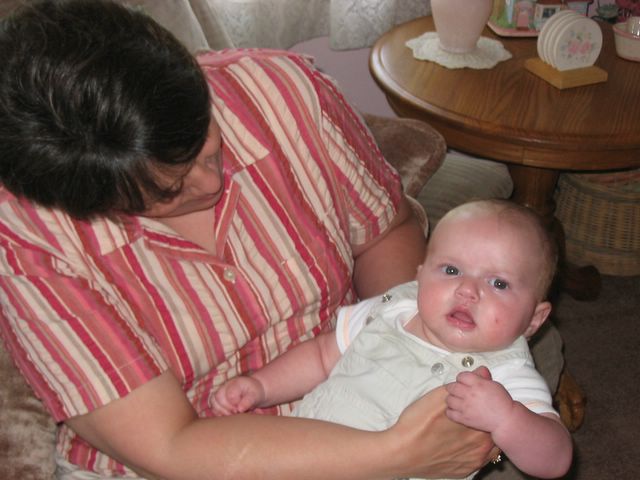
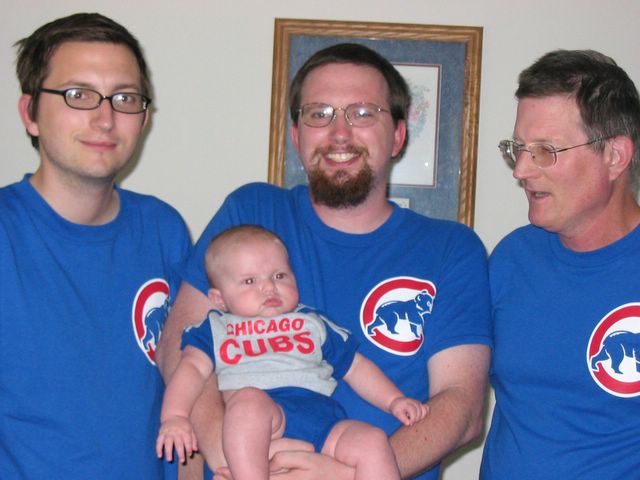
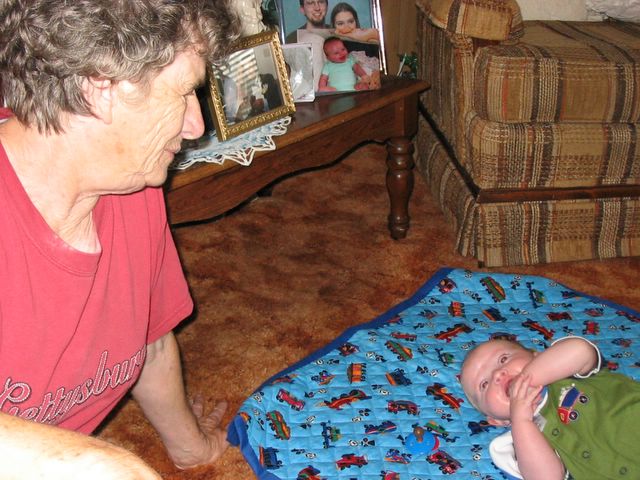
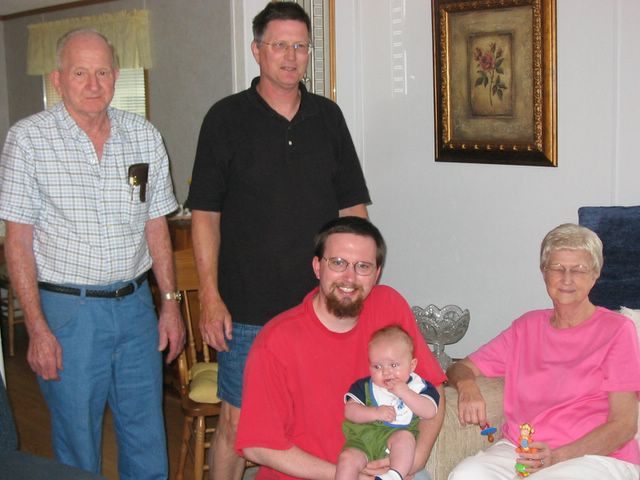
It doesn't seem like a week since we've been back in Georgia--the month of July just flew. Micah will be five months old in just over a week, and Mary and I will be back in our classrooms.
On the reading front, I've got about fifteen cantos of Dante and a chapter of N.T. Wright I'd like to dust off before I go all-Shakespeare for a few months. On the other hand, I have yet to get digging on the new freshman comp textbook--I've got ideas about what I'd like to do with that class this year, but nothing saved yet.
The nice thing is that I've got a laptop now (typing on it right now), so I'll be able to work on those things in places other than my own computer desk and the assigned computer labs around UGA's campus. I'm still getting used to the smaller keyboard and haven't yet broken out the little mouse I bought with it, but the mobility should be just wonderful.
I'll probably wait until I finish one or the other book to start commenting again; for each I've got some things in mind to write but haven't yet solidified them.
On the reading front, I've got about fifteen cantos of Dante and a chapter of N.T. Wright I'd like to dust off before I go all-Shakespeare for a few months. On the other hand, I have yet to get digging on the new freshman comp textbook--I've got ideas about what I'd like to do with that class this year, but nothing saved yet.
The nice thing is that I've got a laptop now (typing on it right now), so I'll be able to work on those things in places other than my own computer desk and the assigned computer labs around UGA's campus. I'm still getting used to the smaller keyboard and haven't yet broken out the little mouse I bought with it, but the mobility should be just wonderful.
I'll probably wait until I finish one or the other book to start commenting again; for each I've got some things in mind to write but haven't yet solidified them.
25 July 2005








09 July 2005
Road Trip
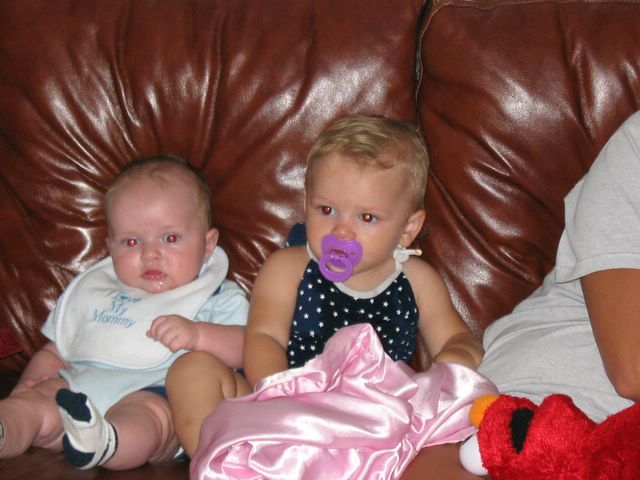
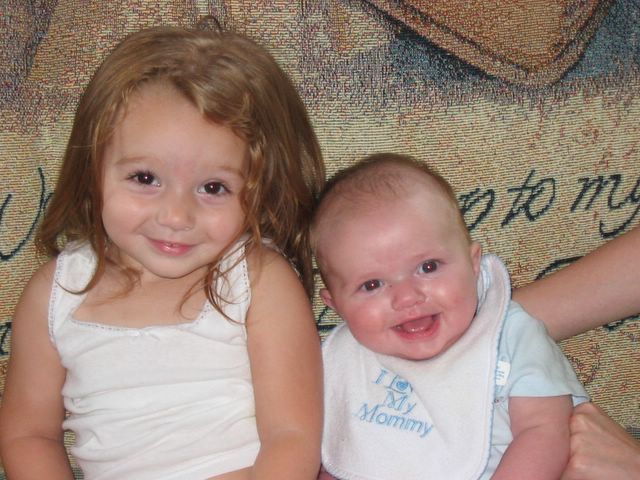
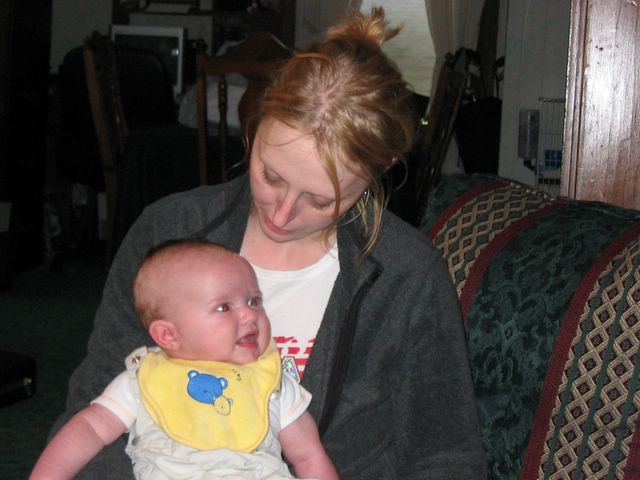
Tomorrow I preach my first sermon in two and a half years, load up the car, and take off for Indiana. I'm already realizing that this is going to be a catch-22; if Micah sleeps at night, he's going to be awake and mad he's in a car seat all day. If he sleeps in the car, he's going to be awake and expecting Mom and Dad to be awake all night. There's just no winning. But perhaps it won't be so bad--it's just my first road trip as Dad.
Subscribe to:
Posts (Atom)


