My lovely readers might have noticed yet another toy on the sidebar. I discovered LibraryThing.com on Julie Clawson's blog, and I've been fiddling with it intermittently since. Right now I've got the blog gizmo set to random because I don't particularly like the "most recently added" setting. Anyway, check out the site--it's easy to use and doesn't involve coughing up any personal information beyond the contents of one's bookshelves.
31 October 2006


30 October 2006
Educating the Guardians
I love talking with freshmen about what the heck they're in college for. That was the subject today, and as usual, Plato provided us a clear, theory-heavy model against which students could push.
Without much effort at all I got both classes thinking about atoms and electrons and the fact that, even though none of us has actually seen an electron, we all believe in them and in fact live electricity-powered lives, secure within a theory no less theory-laden than Plato's theory of justice.
My hope is that we'll get some good freedom papers cooking. We finish up the education section Wednesday, then get into Plato's exploration of false justice/freedom/goodness.
Without much effort at all I got both classes thinking about atoms and electrons and the fact that, even though none of us has actually seen an electron, we all believe in them and in fact live electricity-powered lives, secure within a theory no less theory-laden than Plato's theory of justice.
My hope is that we'll get some good freedom papers cooking. We finish up the education section Wednesday, then get into Plato's exploration of false justice/freedom/goodness.
26 October 2006
Resistance to Civil Government
I stayed away from my standard manner of teaching Thoreau's anti-government essay, and my delivery suffered. In the past I've spent the whole period "playing Thoreau," taking what I take to be his position and answering students' questions in-character.
This semester, because we've spent so much time with Plato, I decided instead to focus the discussion on how Thoreau agrees with and departs from Plato. I think the intellectual content might have been better, but I fear that I took the sting out of Thoreau, and to take the sting out of Thoreau rather negates the primary benefit of reading it as a class.
Tomorrow I'm going to try to get all thirty-five remaining essays graded and marked. If I can manage four an hour, that's a work day. Then, in November, I can devote my time almost exclusively to finishing my own semester's projects. Here's hoping...
This semester, because we've spent so much time with Plato, I decided instead to focus the discussion on how Thoreau agrees with and departs from Plato. I think the intellectual content might have been better, but I fear that I took the sting out of Thoreau, and to take the sting out of Thoreau rather negates the primary benefit of reading it as a class.
Tomorrow I'm going to try to get all thirty-five remaining essays graded and marked. If I can manage four an hour, that's a work day. Then, in November, I can devote my time almost exclusively to finishing my own semester's projects. Here's hoping...
24 October 2006



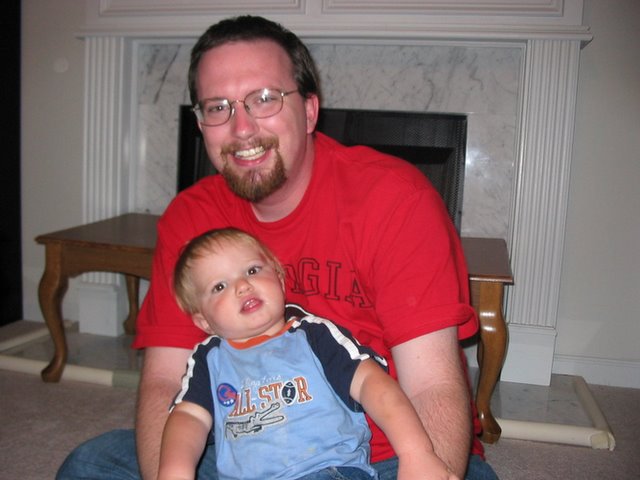




How many of you are there?

I've been Googling about, and I think the other one lives in Washington state.
Revsion and Such
No new Plato material until next Monday, so I get to ramble a bit. (I don't think anyone would stop me were I to ramble anyway, but I need to give myself an excuse on occasion.)
I'm genuinely pleased with what I've seen on this third paper. Last year I had my classes do some research in their potential major or career fields, and the results were miserably spotty. Half a dozen or so wrote genuinely good papers, some didn't have any idea what they wanted to do and thus wrote mediocre papers, and the majority picked the hottest on-every-evening's-news-broadcast topic and wrote that up. Boring overall.
I shouldn't count my chickens before they hatch, but from the buzz I've overheard, this year's papers ought to be both better to read and better for initiating four (or five or six) years of college-level thinking. This year, since I'm teaching Plato rather than an anthology, I'm having them take Republic and one other premodern text (my rough cutoff line is John Milton) and write a paper on some social division, be between teacher and student, domestic and foreign, old and young, men and women, parents and children, or whatever. To develop some rudimentary research skills I'm also requiring that they integrate into their arguments two scholarly sources.
A number of my students have picked biblical texts, and I'm satisfied if that means they've spent a couple weeks thinking rigorously about how the Bible differs from Plato, arguably one of the other great influences on Western thought. Others have picked some protomodern stuff along the lines of Shakespeare and Marlowe. Again, the cross-genre potential means they've had to do some thinking. Still others have gone to Erasmus, Hammurabi, other Plato dialogues, Boethius, and others. I realize that few if any will go to the effort of reading other folks' papers, but at minimum they've done some thinking about two texts that existed before 1700 and that differ from one another. That they can see some historical complexity means that they've done some thinking that otherwise they wouldn't have done.
I hope they've started thinking about the final paper--the assignment for paper four is thus:
What is freedom, and are you free?
For this one we're going to be mixing some Thoreau and some Milton and some Aristotle in with the Plato, and within a week the ones who read are going to have to read Thoreau's case that governments necessarily impede conscience and then Plato's that only a properly aristocratic government can develop conscience. This ought to be fun.
Thoreau's tomorrow. I suppose I ought to plan that lesson.
I'm genuinely pleased with what I've seen on this third paper. Last year I had my classes do some research in their potential major or career fields, and the results were miserably spotty. Half a dozen or so wrote genuinely good papers, some didn't have any idea what they wanted to do and thus wrote mediocre papers, and the majority picked the hottest on-every-evening's-news-broadcast topic and wrote that up. Boring overall.
I shouldn't count my chickens before they hatch, but from the buzz I've overheard, this year's papers ought to be both better to read and better for initiating four (or five or six) years of college-level thinking. This year, since I'm teaching Plato rather than an anthology, I'm having them take Republic and one other premodern text (my rough cutoff line is John Milton) and write a paper on some social division, be between teacher and student, domestic and foreign, old and young, men and women, parents and children, or whatever. To develop some rudimentary research skills I'm also requiring that they integrate into their arguments two scholarly sources.
A number of my students have picked biblical texts, and I'm satisfied if that means they've spent a couple weeks thinking rigorously about how the Bible differs from Plato, arguably one of the other great influences on Western thought. Others have picked some protomodern stuff along the lines of Shakespeare and Marlowe. Again, the cross-genre potential means they've had to do some thinking. Still others have gone to Erasmus, Hammurabi, other Plato dialogues, Boethius, and others. I realize that few if any will go to the effort of reading other folks' papers, but at minimum they've done some thinking about two texts that existed before 1700 and that differ from one another. That they can see some historical complexity means that they've done some thinking that otherwise they wouldn't have done.
I hope they've started thinking about the final paper--the assignment for paper four is thus:
What is freedom, and are you free?
For this one we're going to be mixing some Thoreau and some Milton and some Aristotle in with the Plato, and within a week the ones who read are going to have to read Thoreau's case that governments necessarily impede conscience and then Plato's that only a properly aristocratic government can develop conscience. This ought to be fun.
Thoreau's tomorrow. I suppose I ought to plan that lesson.
20 October 2006
Plato's cave
Just my luck--the day comes to teach Plato's allegory of the cave, and my voice is failing because of a cold. Ah, well. I think that most famous bit of Plato will serve nicely to introduce paper 4, the most philosophical of the papers and thus the hardest. The assignment is to say what freedom is and whether or to what extent each paper's writer is free. Last time I assigned this paper, some fell predictably into high school civics essays, and others couldn't pull together their thoughts on education and responsibility and money, but some rose to the occasion and really did some good thinking on paper. I imagine I'll get the same in this paper.
We also talked a bit about The Matrix and C.S. Lewis's The Silver Chair and their connections to this most famous episode, and we talked at some length about the allegory's place in the larger argument. All the while, though, I was fighting my throat, so what could have been a great moment in the class rather fizzled.
Monday is revision day, but on Wednesday those who come to class are going to discuss Thoreau's "Resistance to Civil Government." That ought to provide a radical enough departure from Plato's live-for-the-city ethos that the class can do some good thinking about freedom and what it means.
We also talked a bit about The Matrix and C.S. Lewis's The Silver Chair and their connections to this most famous episode, and we talked at some length about the allegory's place in the larger argument. All the while, though, I was fighting my throat, so what could have been a great moment in the class rather fizzled.
Monday is revision day, but on Wednesday those who come to class are going to discuss Thoreau's "Resistance to Civil Government." That ought to provide a radical enough departure from Plato's live-for-the-city ethos that the class can do some good thinking about freedom and what it means.
16 October 2006
Human Nature, Empiricism, and Idealism
Today I was far more articulate in 10:00 than in 9:00. I'm trying to use our class's online discussion board to alleviate my ineptitude early, but I'm going to have to do some serious recovering in class Wednesday.
The discussion was supposed to be about Plato's critique of the sophists as moral empiricists, folks who look at the ways people live together and conclude that the best way of living must be the seizure of power within those groups. Plato, contrasting strongly, argues for a moral idealism, the evaluation of good or bad cities and people based on their proximity to or distance from a reasoned ideal of conduct.
So on our WebCT board, I posted this question for them:
What is human nature?
I don't think many of them read this blog (though I've posted a link to it on WebCT), so I'll go ahead and start some thinking on the question.
What I call in class "pop culture" meanings for words are often our launching-points for discussions. When I present the above question to the classes, my hunch is that their answers are going to come either from some sort of evangelical Protestant theology (Calvin lite, if you will) or from some sort of basic understanding of economics or Freudian psychology. What's going to bind them together (I'm guessing, of course) is that all of them will assume that "human nature" is a limiting factor on political possibilities, an insurmountable selfishness that makes sustained communal living impossible.
Plato, of course (along with the book of Acts, if I'm reading it right), denies the absoluteness of that determination, claiming instead that education (in Plato's system) or conversion (in Acts) makes a more real sort of community possible. In other words, what we see when we look at embodied communities is not human nature but human-nature-corrupted.
I'm not sure where I stand on this question, which will make leading the discussion easier. I've been just as influenced as anyone by the American project, a system of rules and checks that limits the ability of any one person to act too autonomously in matters of government. But I also think that genuinely good people can be genuinely good leaders, defying claims that human greed is insurmountable. I hope this discussion runs better than this morning's did.
The discussion was supposed to be about Plato's critique of the sophists as moral empiricists, folks who look at the ways people live together and conclude that the best way of living must be the seizure of power within those groups. Plato, contrasting strongly, argues for a moral idealism, the evaluation of good or bad cities and people based on their proximity to or distance from a reasoned ideal of conduct.
So on our WebCT board, I posted this question for them:
What is human nature?
I don't think many of them read this blog (though I've posted a link to it on WebCT), so I'll go ahead and start some thinking on the question.
What I call in class "pop culture" meanings for words are often our launching-points for discussions. When I present the above question to the classes, my hunch is that their answers are going to come either from some sort of evangelical Protestant theology (Calvin lite, if you will) or from some sort of basic understanding of economics or Freudian psychology. What's going to bind them together (I'm guessing, of course) is that all of them will assume that "human nature" is a limiting factor on political possibilities, an insurmountable selfishness that makes sustained communal living impossible.
Plato, of course (along with the book of Acts, if I'm reading it right), denies the absoluteness of that determination, claiming instead that education (in Plato's system) or conversion (in Acts) makes a more real sort of community possible. In other words, what we see when we look at embodied communities is not human nature but human-nature-corrupted.
I'm not sure where I stand on this question, which will make leading the discussion easier. I've been just as influenced as anyone by the American project, a system of rules and checks that limits the ability of any one person to act too autonomously in matters of government. But I also think that genuinely good people can be genuinely good leaders, defying claims that human greed is insurmountable. I hope this discussion runs better than this morning's did.
12 October 2006
Particular Plato
My discussions over sex and child-rearing in Plato were less than satisfactory; I could not keep together the disparate elements and form them into coherent discussions. Plato's jumps from new ways of marriage to child-rearing practices to the use of sex to motivate soldiers to the culture of hero-worship to the treatment of Greek captives and corpses in war to the control of the community's population levels outjumped me, and we lacked a center the last couple days.
When I go in Friday, I'm going to emphasize that with those discussions, we get Plato actually working out in detail the theory that he took so long to set up beforehand and that we as readers must engage the general theory even if the particulars fall short. I pointed to that with an exercise I had the students do (they were to formulate a thesis that critiques Plato's general project), but I never explicitly stated it.
Midterms are still kicking my butt. The Latin and Old English exams are out of the way, but I still have several pages to write on my Spenser paper, and I've only marked up a third or so of my freshmen's papers. I've still miles to go before I sleep.
When I go in Friday, I'm going to emphasize that with those discussions, we get Plato actually working out in detail the theory that he took so long to set up beforehand and that we as readers must engage the general theory even if the particulars fall short. I pointed to that with an exercise I had the students do (they were to formulate a thesis that critiques Plato's general project), but I never explicitly stated it.
Midterms are still kicking my butt. The Latin and Old English exams are out of the way, but I still have several pages to write on my Spenser paper, and I've only marked up a third or so of my freshmen's papers. I've still miles to go before I sleep.
06 October 2006
Moral education and levels of engagement
The weather report this morning called for highs in the seventies and partly-cloudy skies, so I decided to take my classes outside. 10:00 really is just a quiet group of people; even outside of the tunnel that is Park 123, they didn't talk much. I can deal with that; it just means that I'm going to have to structure discussions differently.
Today's reading was the culmination of Plato's definition of morality. We rehearsed the argument, namely that morality consists of the reason's governing the apetites with the help of the passions, and the students seemed to follow the logic. We talked about modern suspicions about reason and the distinction English still maintains in the words "rational" and "rationalize." Overall we had a good class.
At the end of each class I asked them what they thought about UGA's occasional desire to incorporate moral learning into the curriculum. Almost all agreed that the "alcohol meetings" under which fraternities and sororities suffer are infantilizing and resemble what Plato prescribes for pre-rational children. The verdict was split with regards to instruction in what Plato and Aristotle would call moral reasoning. Some said that what capacity for moral reasoning we might develop has already developed before we arrive on campus. Others thought that we could still develop morally.
If this looks like I'm lobbying for that job should it appear, perhaps I am. If indeed the university gets serious about some sort of moral education into the undergrad experience, I'd probably put my resume in for the job. I suppose I'd treat it in Platonic terms: I wouldn't necessarily want that responsibility, but I'd be afraid that some idjit would get the job and really muck things up.
Today's reading was the culmination of Plato's definition of morality. We rehearsed the argument, namely that morality consists of the reason's governing the apetites with the help of the passions, and the students seemed to follow the logic. We talked about modern suspicions about reason and the distinction English still maintains in the words "rational" and "rationalize." Overall we had a good class.
At the end of each class I asked them what they thought about UGA's occasional desire to incorporate moral learning into the curriculum. Almost all agreed that the "alcohol meetings" under which fraternities and sororities suffer are infantilizing and resemble what Plato prescribes for pre-rational children. The verdict was split with regards to instruction in what Plato and Aristotle would call moral reasoning. Some said that what capacity for moral reasoning we might develop has already developed before we arrive on campus. Others thought that we could still develop morally.
If this looks like I'm lobbying for that job should it appear, perhaps I am. If indeed the university gets serious about some sort of moral education into the undergrad experience, I'd probably put my resume in for the job. I suppose I'd treat it in Platonic terms: I wouldn't necessarily want that responsibility, but I'd be afraid that some idjit would get the job and really muck things up.
05 October 2006
Upcoming sermon
Amos 5:6-15:
6Seek the Lord and live, or he will break out against the house of Joseph like fire, and it will devour Bethel, with no one to quench it. 7Ah, you that turn justice to wormwood, and bring righteousness to the ground! 8The one who made the Pleiades and Orion, and turns deep darkness into the morning, and darkens the day into night, who calls for the waters of the sea, and pours them out on the surface of the earth, the Lord is his name, 9who makes destruction flash out against the strong, so that destruction comes upon the fortress. 10They hate the one who reproves in the gate, and they abhor the one who speaks the truth. 11Therefore because you trample on the poor and take from them levies of grain, you have built houses of hewn stone, but you shall not live in them; you have planted pleasant vineyards, but you shall not drink their wine. 12For I know how many are your transgressions, and how great are your sins— you who afflict the righteous, who take a bribe, and push aside the needy in the gate. 13Therefore the prudent will keep silent in such a time; for it is an evil time. 14Seek good and not evil, that you may live; and so the Lord, the God of hosts, will be with you, just as you have said. 15Hate evil and love good, and establish justice in the gate; it may be that the Lord, the God of hosts, will be gracious to the remnant of Joseph.
There's my text for October 15. I'll preach about a seven-minute homily on that, then Ben will do the same for Mark 10:17-31. Then I'll do a brief (one-minute, roughly) improvisational oration based on his sermon, then he'll do one based on my response, and so on. It went over very well the first time, and I imagine it will again this time.
Once again I find myself taking Erasmus's side over Luther's; the presence of these strong imperatives, and the absence of hand-wringing appeals to "the fall" simply do not allow room for Luther's sin-awareness-turned-cynicism that one sees when the Peasants' Revolt goes down. YHWH expects Israel to be just because YHWH said so, and there will be no excuses for the exploitation that characterizes their life together. There will, however, be punishment. Just as the poor build houses for the rich, so the rich have paid for houses for the invaders (or, more likely, for the rats).
The bit that strikes me most about this passage in Amos is the assumed correspondence between God's orderly and good creation and the expectation that Israel's life together will be orderly and good. There's no sense of inevitability there, no hedging of bets because of "human nature" or "economic forces." I don't see how I can avoid setting up that tone in my part of the sermon on October 15, but I also don't see how I can avoid hitting Ben's strong Lutheran reading of the Mark passage as a truck hits a deer.
I suppose we'll have to see...
6Seek the Lord and live, or he will break out against the house of Joseph like fire, and it will devour Bethel, with no one to quench it. 7Ah, you that turn justice to wormwood, and bring righteousness to the ground! 8The one who made the Pleiades and Orion, and turns deep darkness into the morning, and darkens the day into night, who calls for the waters of the sea, and pours them out on the surface of the earth, the Lord is his name, 9who makes destruction flash out against the strong, so that destruction comes upon the fortress. 10They hate the one who reproves in the gate, and they abhor the one who speaks the truth. 11Therefore because you trample on the poor and take from them levies of grain, you have built houses of hewn stone, but you shall not live in them; you have planted pleasant vineyards, but you shall not drink their wine. 12For I know how many are your transgressions, and how great are your sins— you who afflict the righteous, who take a bribe, and push aside the needy in the gate. 13Therefore the prudent will keep silent in such a time; for it is an evil time. 14Seek good and not evil, that you may live; and so the Lord, the God of hosts, will be with you, just as you have said. 15Hate evil and love good, and establish justice in the gate; it may be that the Lord, the God of hosts, will be gracious to the remnant of Joseph.
There's my text for October 15. I'll preach about a seven-minute homily on that, then Ben will do the same for Mark 10:17-31. Then I'll do a brief (one-minute, roughly) improvisational oration based on his sermon, then he'll do one based on my response, and so on. It went over very well the first time, and I imagine it will again this time.
Once again I find myself taking Erasmus's side over Luther's; the presence of these strong imperatives, and the absence of hand-wringing appeals to "the fall" simply do not allow room for Luther's sin-awareness-turned-cynicism that one sees when the Peasants' Revolt goes down. YHWH expects Israel to be just because YHWH said so, and there will be no excuses for the exploitation that characterizes their life together. There will, however, be punishment. Just as the poor build houses for the rich, so the rich have paid for houses for the invaders (or, more likely, for the rats).
The bit that strikes me most about this passage in Amos is the assumed correspondence between God's orderly and good creation and the expectation that Israel's life together will be orderly and good. There's no sense of inevitability there, no hedging of bets because of "human nature" or "economic forces." I don't see how I can avoid setting up that tone in my part of the sermon on October 15, but I also don't see how I can avoid hitting Ben's strong Lutheran reading of the Mark passage as a truck hits a deer.
I suppose we'll have to see...
04 October 2006
Common Good and indoctrination
The last couple days' discussion haven't left a consistent impression upon my memory. In the afternoon I remember them going well, yet by evening, I can't articulate whether or not I taught anything, much less what I might have taught.
Monday we dug into the question of community size and common good in 9:00. Plato insists that a community that becomes too large is not a community any more. My students seemed to think that UGA is still a community, despite its size, but I don't think I led the conversation down too many roads helpful for answering that. My impression is that UGA is less a community, dedicated to an intelligible common good, and more a shopping mall of sorts. One picks up staple credit-hours from mine and others' required classes, invests in skill-set-stock in one's major classes, and buys overpriced drinks at clubs on weekends. Yes, the metaphor became less abstract on that last one. Deal with it.
In 10:00 our discussion dealt more with the question of Plato's noble lie. Again, students' willingness to accept a lying government shocked me. We also had a fairly fruitful discussion about why a community would want guardians rather than a democracy.
Today's discussion focused more on indoctrination and Plato's unflinching praise of it. My students, in a way that surprised me, seemed for the most part willing to accept indoctrination as a potentially good thing. Hauerwas, I'm sure, would be pleased. I'm not. Of course, I have to blame myself for that lapsed teaching moment--had I set up the discussion better, perhaps I could have rendered a bit more of the shock of Plato's praise of brainwashing. Perhaps not.
And here I sit, having graded (but not marked up) about a third of their second papers. Back to the grind.
Monday we dug into the question of community size and common good in 9:00. Plato insists that a community that becomes too large is not a community any more. My students seemed to think that UGA is still a community, despite its size, but I don't think I led the conversation down too many roads helpful for answering that. My impression is that UGA is less a community, dedicated to an intelligible common good, and more a shopping mall of sorts. One picks up staple credit-hours from mine and others' required classes, invests in skill-set-stock in one's major classes, and buys overpriced drinks at clubs on weekends. Yes, the metaphor became less abstract on that last one. Deal with it.
In 10:00 our discussion dealt more with the question of Plato's noble lie. Again, students' willingness to accept a lying government shocked me. We also had a fairly fruitful discussion about why a community would want guardians rather than a democracy.
Today's discussion focused more on indoctrination and Plato's unflinching praise of it. My students, in a way that surprised me, seemed for the most part willing to accept indoctrination as a potentially good thing. Hauerwas, I'm sure, would be pleased. I'm not. Of course, I have to blame myself for that lapsed teaching moment--had I set up the discussion better, perhaps I could have rendered a bit more of the shock of Plato's praise of brainwashing. Perhaps not.
And here I sit, having graded (but not marked up) about a third of their second papers. Back to the grind.
28 September 2006
I suppose I am a liberal
"True, these principles sound pretty elementary -- "we're pro-free speech and anti-gratuitous violence" -- but in the days since the pope's sermon, I don't feel that I've heard them defended in anything like a unanimous chorus."
I read this call for free speech and a free press, hallmarks of those liberal Ameri-Brits of the late eighteenth century, and I agree heartily. Perhaps what they say about college teachers' being liberal is true after all.
Click on the post's title for the full article.
I read this call for free speech and a free press, hallmarks of those liberal Ameri-Brits of the late eighteenth century, and I agree heartily. Perhaps what they say about college teachers' being liberal is true after all.
Click on the post's title for the full article.
27 September 2006
Nihil sub sole novum
There is nothing new under the sun.
But you haven't been around that long, cynic.
There is nothing new under the sun.
But you haven't seen nearly as much, traditionalist.
There is nothing new under the sun.
But you stand on the earth under its light, not beside it as its brother.
There is nothing new under the sun.
But in your threescore and ten, there is plenty new before you.
But you haven't been around that long, cynic.
There is nothing new under the sun.
But you haven't seen nearly as much, traditionalist.
There is nothing new under the sun.
But you stand on the earth under its light, not beside it as its brother.
There is nothing new under the sun.
But in your threescore and ten, there is plenty new before you.
26 September 2006
An Extra in Bartholomew Fair
I'm about to head upstairs to play the Puritan for my office mate's surprise classroom production of Jonson's Bartholomew Fair. Typecasting? Probably. No matter; one has to love a play in which a Puritan loses a theological debate to a puppet, even if one doesn't entirely dislike Puritans.
I'm looking forward to digging back into Republic with my classes. These conferences have been valuable, I think, but Plato is just more fun. I think we're coming up on the wives and children passage--if they don't get riled about that, they're just not reading.
I'm looking forward to digging back into Republic with my classes. These conferences have been valuable, I think, but Plato is just more fun. I think we're coming up on the wives and children passage--if they don't get riled about that, they're just not reading.
22 September 2006
Plato's Guardians and UGA's... what?
We finished up our second Plato "unit" (actually just read enough pages to get to paper 2's revision days) with a haphazard discussion of whether or not UGA students are somehow analogous to Plato's guardians. Some folks seem pretty comfortable with the assertion that college students are there for self-improvement primarily, while others have some idea that they (we) ought to benefit "society" but have trouble articulating who counts as "society" and what concrete benefit college-educated folks confer that high-school-educated folks couldn't.
At Milligan the answers were much clearer. From our opening-week Matriculation ceremony to the commencement ceremony, Milligan let us know that we are indeed the next generation's guardians and that our intellectual pursuits ought to serve the Church make meaning out of God's fallen world even as our vocations, be they education or business or preaching, ought to seek justice, the corrollary of God's good ordering of the world. The "we" was clear, and the expectations were clear.
There are days when I wish I could give the same sort of clarity to my students here at the University, but every time I try, I fade into some fuzzy sentimental idea about "universal humanity" or "local community" or some such. There's nothing wrong with either of those, but without a clearer sense of who "we" are and whom "we" serve, concrete action is hard to imagine. Like my students, I'm not quite sure why we're here. I think that Plato's basic idea of morality, the strong working to benefit the weak, ought to apply, but I'm not sure how.
I think this is at least partly why my students want to return to a sort of omission-model when they talk about morality. UGA students must not be a guardian class, because they don't refrain from smoking, drinking, chewing, and screwing. Plato names those vices as well (along with pastries), but in his treatise, to abstain from such things would not itself be morality but would open up more space in which morality could take place.
To bring this back to the particular, my students look at me as if I were from another planet when I tell them that Milligan had no football team and that a significant hunk of the students, from majors as diverse as business and television communications and Bible and nursing, would consider as a viable option for a Friday night a long night at the coffee house talking philosophy and theology. I'm not making that up--I can think of a number of nights and a wide swath of people who indulged in just that on a regular basis. We also played games and watched movies and took in local bands on other nights, but there was no sense that the weekend necessarily had to involve turning off one's brain for three days.
Admittedly, I'm not as familiar with undergrad culture here as someone ought to be before making these kinds of statements. There might be pockets of weekend intellectuals I just haven't encountered. But in the absence of a clear guardian-vocation, I do see that there's a massive business of turning these four (or six) years of students' lives into one long spring break--do whatcha needs to do to graduate, but certainly don't order your life around intellectual activity.
That's not to say that Milligan is necessarily superior in every way. But in these ways, it is clearer.
At Milligan the answers were much clearer. From our opening-week Matriculation ceremony to the commencement ceremony, Milligan let us know that we are indeed the next generation's guardians and that our intellectual pursuits ought to serve the Church make meaning out of God's fallen world even as our vocations, be they education or business or preaching, ought to seek justice, the corrollary of God's good ordering of the world. The "we" was clear, and the expectations were clear.
There are days when I wish I could give the same sort of clarity to my students here at the University, but every time I try, I fade into some fuzzy sentimental idea about "universal humanity" or "local community" or some such. There's nothing wrong with either of those, but without a clearer sense of who "we" are and whom "we" serve, concrete action is hard to imagine. Like my students, I'm not quite sure why we're here. I think that Plato's basic idea of morality, the strong working to benefit the weak, ought to apply, but I'm not sure how.
I think this is at least partly why my students want to return to a sort of omission-model when they talk about morality. UGA students must not be a guardian class, because they don't refrain from smoking, drinking, chewing, and screwing. Plato names those vices as well (along with pastries), but in his treatise, to abstain from such things would not itself be morality but would open up more space in which morality could take place.
To bring this back to the particular, my students look at me as if I were from another planet when I tell them that Milligan had no football team and that a significant hunk of the students, from majors as diverse as business and television communications and Bible and nursing, would consider as a viable option for a Friday night a long night at the coffee house talking philosophy and theology. I'm not making that up--I can think of a number of nights and a wide swath of people who indulged in just that on a regular basis. We also played games and watched movies and took in local bands on other nights, but there was no sense that the weekend necessarily had to involve turning off one's brain for three days.
Admittedly, I'm not as familiar with undergrad culture here as someone ought to be before making these kinds of statements. There might be pockets of weekend intellectuals I just haven't encountered. But in the absence of a clear guardian-vocation, I do see that there's a massive business of turning these four (or six) years of students' lives into one long spring break--do whatcha needs to do to graduate, but certainly don't order your life around intellectual activity.
That's not to say that Milligan is necessarily superior in every way. But in these ways, it is clearer.
19 September 2006
Censorship
Discussion went well yesterday, though I should have planned better in both cases. We established that censorship can happen in all kinds of contexts and all kinds of reasons but did not have enough time in the end to explore the possibility of evaluating those acts of censorship.
Ah, well. At least we got to think about it.
Tomorrow we finish the section on the city-guardians' education and take a week's break from reading to do revision groups, so no Plato for a little while.
On October 15 I'll be doing another team-sermon with Ben, this time on Amos and Mark, so I suppose the respite from Plato reading won't leave me with nothing to read.
Ah, well. At least we got to think about it.
Tomorrow we finish the section on the city-guardians' education and take a week's break from reading to do revision groups, so no Plato for a little while.
On October 15 I'll be doing another team-sermon with Ben, this time on Amos and Mark, so I suppose the respite from Plato reading won't leave me with nothing to read.
16 September 2006





14 September 2006
The Ring of Gyges
Imagine that there's a ring that turns one invisible, that one could do anything, moral or immoral, without being seen.
(No, not even by the hellish bad guys in Lord of the Rings.)
Now imagine that one had the resources to hire sorcerors, wizards who could by magic arts convince even the gods that one's life were perfectly moral.
(I know, I know--they wouldn't be very impressive gods if sorcerors could thus fool them. Work with me here.)
Would anyone still be moral?
Thus ended one of the best discussions that we've had in freshman comp thus far. I started the final segment of class with a little game. In a blind-voting exercise, I had them raise their hands if they thought they'd remain moral if they could remove all heavenly and earthly consequences of their immorality. Neither class had more than two out of twenty raise their hands. Then I had them raise their hands if they thought that they knew three people who, under the same circumstances, would remain moral. In both classes, more than half the class knew such people.
Such self-doubt is encouraging, really--in a Chesterton sense, these folks believe that good life is possible but doubt that their own capacities can reach it. That's not bad for a bunch of folks whom some commentators have called a relativistic and self-absorbed generation. (Those of us who spend our lives around college students know it's a hair more complicated than that.)
We also delved into the categories of good-in-itself and good-for-the-consequences, and both classes were quite willing to categorize, reconsider, and debate whether such things as love, family, and puppies belong properly in either of those categories. For a thirteen-page reading assignment, we dug into some pretty heavy material yesterday.
A colleague of mine, who has the classroom after the period I teach, asked when I'd start introducing some Derridean deconstructions of Plato's project. I think Plato's project is more than enough for one semester; I've been coming back to it for a dozen years and don't have a strong grasp yet. In fact, Derrida famously said at a talk at Villanova that "Plato is always before me."
I'll leave deconstruction to the deconstructionists.
(No, not even by the hellish bad guys in Lord of the Rings.)
Now imagine that one had the resources to hire sorcerors, wizards who could by magic arts convince even the gods that one's life were perfectly moral.
(I know, I know--they wouldn't be very impressive gods if sorcerors could thus fool them. Work with me here.)
Would anyone still be moral?
Thus ended one of the best discussions that we've had in freshman comp thus far. I started the final segment of class with a little game. In a blind-voting exercise, I had them raise their hands if they thought they'd remain moral if they could remove all heavenly and earthly consequences of their immorality. Neither class had more than two out of twenty raise their hands. Then I had them raise their hands if they thought that they knew three people who, under the same circumstances, would remain moral. In both classes, more than half the class knew such people.
Such self-doubt is encouraging, really--in a Chesterton sense, these folks believe that good life is possible but doubt that their own capacities can reach it. That's not bad for a bunch of folks whom some commentators have called a relativistic and self-absorbed generation. (Those of us who spend our lives around college students know it's a hair more complicated than that.)
We also delved into the categories of good-in-itself and good-for-the-consequences, and both classes were quite willing to categorize, reconsider, and debate whether such things as love, family, and puppies belong properly in either of those categories. For a thirteen-page reading assignment, we dug into some pretty heavy material yesterday.
A colleague of mine, who has the classroom after the period I teach, asked when I'd start introducing some Derridean deconstructions of Plato's project. I think Plato's project is more than enough for one semester; I've been coming back to it for a dozen years and don't have a strong grasp yet. In fact, Derrida famously said at a talk at Villanova that "Plato is always before me."
I'll leave deconstruction to the deconstructionists.
11 September 2006
Morality as Reason
10 o'clock class was tired today.
That or I'm just not connecting with their corporate personality the way I connect with 9 o'clock. However one slices it, my first discussion session went better than my second.
Teaching Republic once again has me thinking about "western culture" as an abstraction and the alienness of the texts that folks name as the classics of "western culture." For instance, just about all my students (in both sections) named something other than Reason as the source of morality. I would have too were I not teaching Plato. Folks' opinions certainly differ, but whether a student espoused a quasi-solipsism or a divine mandate, nobody seemed to want to put reason in the driver's seat of the morality bus.
I realize that such developments are modern developments, that Augustine and Aristotle would have named reason as an engine of morality where Hume and Freud would not. But that's precisely the problem with abstracting "western culture" from its tangled history--there's no there there!
Anyway, I've got to get a better set of notes going for Friday's discussion. Until I'm convinced that the disconnect is insurmountable, I'm going to have to keep plugging away at my sleepy section.
That or I'm just not connecting with their corporate personality the way I connect with 9 o'clock. However one slices it, my first discussion session went better than my second.
Teaching Republic once again has me thinking about "western culture" as an abstraction and the alienness of the texts that folks name as the classics of "western culture." For instance, just about all my students (in both sections) named something other than Reason as the source of morality. I would have too were I not teaching Plato. Folks' opinions certainly differ, but whether a student espoused a quasi-solipsism or a divine mandate, nobody seemed to want to put reason in the driver's seat of the morality bus.
I realize that such developments are modern developments, that Augustine and Aristotle would have named reason as an engine of morality where Hume and Freud would not. But that's precisely the problem with abstracting "western culture" from its tangled history--there's no there there!
Anyway, I've got to get a better set of notes going for Friday's discussion. Until I'm convinced that the disconnect is insurmountable, I'm going to have to keep plugging away at my sleepy section.
09 September 2006
Morality and Power
Friday (yesterday) we covered the rambling opening to Republic and the first salvos between Socrates and Thrasmychus. Once again, unlike the three-year-old comp anthologies, which always seem dated, my classes dug into the two-millennium-old debates about morality and power with a vengeance. As C.S. Lewis promises, the students have found this stuff, thus far, for the most part, delightful.
Within a few minutes each section helped me diagram the basic difference between Socrates' position and Thrasmychus': For the latter, morality is a tool by which the strong make the weak work the strong's benefit. For the former, morality is the strong working for the benefit of the week. (Incidentally, I did better Friday at having two distinct conversations.) In both classes, we found Socrates' account more logical but could generate more cases of Thrasmychus' bearing out.
As we keep cooking through this, I've got to remember to set time aside early for writing instruction; I ran out of time on Friday. Already, having marked only ten papers up, I can tell that I'm going to have to do some instruction on independent and dependent clauses. No surprises there; such is the stuff of the early weeks of FYC.
Within a few minutes each section helped me diagram the basic difference between Socrates' position and Thrasmychus': For the latter, morality is a tool by which the strong make the weak work the strong's benefit. For the former, morality is the strong working for the benefit of the week. (Incidentally, I did better Friday at having two distinct conversations.) In both classes, we found Socrates' account more logical but could generate more cases of Thrasmychus' bearing out.
As we keep cooking through this, I've got to remember to set time aside early for writing instruction; I ran out of time on Friday. Already, having marked only ten papers up, I can tell that I'm going to have to do some instruction on independent and dependent clauses. No surprises there; such is the stuff of the early weeks of FYC.
31 August 2006
The Crito
Is doing injustice to an unjust city an injustice?
Such was our discussion matter yesterday in freshman comp, and although I did better responding to the actual shape of the discussion in 9:00, both classes had good things to say about duty, freedom, and justice.
(One discipline that I've yet to master is keeping previous teaching sessions out of the one I'm conducting. I've found myself more than once this semester attempting to force 10:00 into the same discussion that 9:00 had. Afterwards I realize that very good things could have come from what the folks in 10:00 actually said, but as I noted, I'm no master of that discipline yet. --A pretty good reason not to cut TA teaching loads.)
Okay, so I used a Nietzschean aphorism-dash. Yes, I'm derivative.
Anyway, back to Plato. Although we lacked the time to do hard-core discussions about duties and privilege and such, we did start to explore Plato's absolutism and its tendency to sit ill with our preference for self-determination.
This week we're doing peer revision, but next week, we get into Republic, and we begin with Thrasmychus's claim that morality is a tool of the strong that serves to keep the weak in their place. Not as sophisticated as Machiavelli or Marx or Nietzsche or Freud or Foucault or Greenblatt, admittedly, but I figure I'll let them have a run at the punching bag before they start to read the ones that punch back.
Such was our discussion matter yesterday in freshman comp, and although I did better responding to the actual shape of the discussion in 9:00, both classes had good things to say about duty, freedom, and justice.
(One discipline that I've yet to master is keeping previous teaching sessions out of the one I'm conducting. I've found myself more than once this semester attempting to force 10:00 into the same discussion that 9:00 had. Afterwards I realize that very good things could have come from what the folks in 10:00 actually said, but as I noted, I'm no master of that discipline yet. --A pretty good reason not to cut TA teaching loads.)
Okay, so I used a Nietzschean aphorism-dash. Yes, I'm derivative.
Anyway, back to Plato. Although we lacked the time to do hard-core discussions about duties and privilege and such, we did start to explore Plato's absolutism and its tendency to sit ill with our preference for self-determination.
This week we're doing peer revision, but next week, we get into Republic, and we begin with Thrasmychus's claim that morality is a tool of the strong that serves to keep the weak in their place. Not as sophisticated as Machiavelli or Marx or Nietzsche or Freud or Foucault or Greenblatt, admittedly, but I figure I'll let them have a run at the punching bag before they start to read the ones that punch back.
26 August 2006
The Apology
Yesterday's classes went well. It's amazing what a difference the class's text makes. A year ago, trying to take seriously restaurant reviews and essays about blue jeans, I had to reiterate nearly every class session why we were in fact doing the freshman English thing.
A year later, I replace the MTV-esque FYC anthology with Plato, and every freshman is taking the class seriously. Perhaps I'm going cultural-conservative as I approach my thirtieth birthday, but as long as I'm teaching incoming freshman, I'm going to treat them as college students, not as consumers. They'll read Plato because it's good for them, and if they drop the class, it's because they're not ready for real education yet.
Wow, am I ever on a power trip...
A year later, I replace the MTV-esque FYC anthology with Plato, and every freshman is taking the class seriously. Perhaps I'm going cultural-conservative as I approach my thirtieth birthday, but as long as I'm teaching incoming freshman, I'm going to treat them as college students, not as consumers. They'll read Plato because it's good for them, and if they drop the class, it's because they're not ready for real education yet.
Wow, am I ever on a power trip...
25 August 2006
Back to school
Well, the summer blogging thing didn't really pan out.
Now I'm back at UGA, taking two language classes and one poetry class, teaching two classes on Plato, and finally succumbing to peer pressure and setting up a FaceBook page.
Nothing lengthy or profound now; I've got to get over to Park Hall and teach. We're doing Plato's Apology today, so I might start doing the professo-blog thing and documenting the experience.
Or not.
Now I'm back at UGA, taking two language classes and one poetry class, teaching two classes on Plato, and finally succumbing to peer pressure and setting up a FaceBook page.
Nothing lengthy or profound now; I've got to get over to Park Hall and teach. We're doing Plato's Apology today, so I might start doing the professo-blog thing and documenting the experience.
Or not.
07 August 2006



20 July 2006

19 July 2006




 Micah's number one!
Subscribe to:
Posts (Atom)

